A Late-Autumn Window-Sill Reset for Shorter Days
A late-autumn window-sill reset clears dust, protects plants and makes room for useful daylight, with a simple routine that stays small.
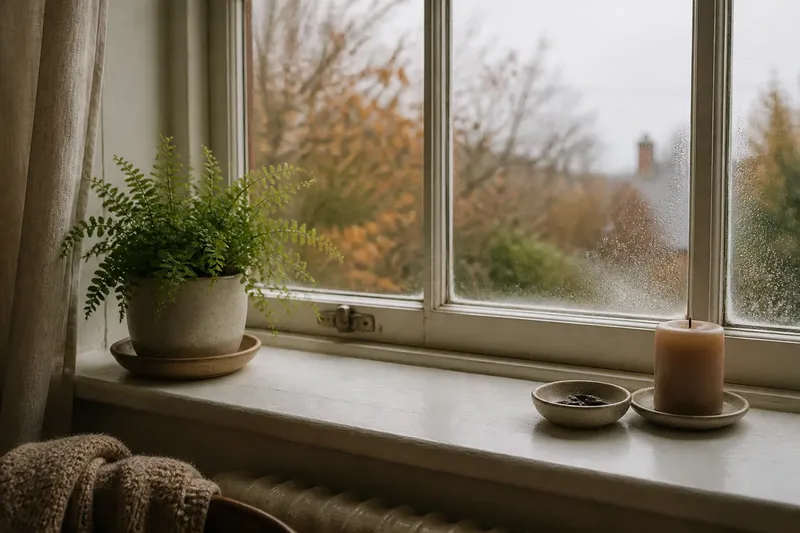
On a grey afternoon, the window sill can seem to collect the whole season: a dry leaf, a ring from a plant pot, and a candle that has not been lit since the evenings were lighter. A late-autumn window-sill reset is a small way to clear that strip of space and make it work better for shorter days, without turning the room into a decorating project.
Let the changing light set the purpose
In late autumn, daylight often arrives at a lower angle and leaves the sill in a different pattern. Before moving anything, notice where the light falls in the morning and afternoon, and whether a radiator, draught or condensation affects the window. The aim is not to make the sill look full; it is to leave what belongs there and give the light a clear path.
Choose one practical purpose for the space. It might be a place for a plant that suits the available light, a small lamp for the early evening, or simply an unobstructed view. A narrow cottage sill may only accommodate one or two objects comfortably. Decide what you want it to do before reaching for extra ornaments.
Clear the sill before arranging it
Lift everything off, including plant saucers and small items that have settled behind the curtains. Put the objects on a nearby table rather than on the floor, where they can be checked without becoming a second job. Wipe the sill with a soft cloth and a cleaner suitable for its finish; use a dry cloth afterwards if moisture could linger around the frame.
Look for dust caught at the edges, water marks beneath pots, and leaves pressed against the glass. These small signs help you decide what needs attention. If condensation is present, dry the sill and keep an eye on whether it returns; do not conceal dampness beneath a tray or decoration.
This is also a good moment to remove anything that has no current use. A summer postcard, an empty seed packet and a chipped pot that is not being used can go elsewhere or be put away. Keeping the cleared sill visible is often more useful than filling it again simply because there is room.
Return only what suits the season
Sort the items on the table into three simple groups: useful here, useful elsewhere, and ready to put away or discard. A plant may stay if its light and temperature needs suit the position. A candle may be pleasant nearby, but leave it away from curtains and never leave a lit flame unattended. A small dish can gather keys or matches only if it does not crowd the glass or block the window latch.
Consider the materials as well as the objects. Unglazed terracotta can leave marks if water escapes, so a sound saucer or protective mat may help. A woven basket can soften the arrangement but may collect dust and damp if it sits against a cold, wet pane. Choose pieces that can be lifted easily for cleaning and that will not be harmed by the conditions at the window.
Say you have a north-facing sill with a small fern, a ceramic pot and a jar of spare buttons. Imagine checking the light and noticing that the fern’s leaves are brushing the damp glass. You move the jar to a sewing shelf, set the fern slightly back on a suitable saucer, and leave the remaining space open; the expected visible change is a clear strip of glass and leaves no longer touching it.
Keep the arrangement easy to tend
Once the useful objects are back, leave enough room to open the window and reach the frame. Avoid placing anything where it can tip if the sash moves or where a curtain will drag it onto the floor. If the sill is shallow, a single plant or a small lamp may be plenty. Empty space is not unfinished; it makes routine care simpler.
For plants, check the pot and saucer rather than watering by season alone. Indoor conditions vary, and a plant near a cold pane may need different attention from one farther into the room. Remove fallen leaves and turn the pot only if that suits the plant’s needs. For lamps, keep the cord tidy and clear of moving parts, and follow the maker’s instructions for placement and use.
What is not worth the effort is buying a new arrangement just to mark the season. A fresh bunch of foliage or a carefully chosen object can be lovely, but neither is needed for a useful reset. The best result may be one less thing to dust.
What should stay on a late-autumn window sill?
Should a houseplant stay by a cold window?
It depends on the plant and the conditions around the glass. Check its care label or a reliable plant-care source, and move it if cold draughts, wet leaves or a sudden change in light seem unsuitable.
How can I keep pots from marking the sill?
Use a stable, watertight saucer or a protective mat that can be lifted for cleaning. Check underneath it now and then so trapped moisture does not go unnoticed.
Can I leave candles on the sill?
An unlit candle can be stored there if it is stable and does not obstruct the window. For a lit candle, keep it well away from curtains and other combustible materials, and never leave it unattended.
How often should I repeat the reset?
There is no fixed schedule: repeat it when dust, water marks or unused objects start to gather. A quick wipe while tending a plant is often enough to keep the sill manageable.
Let the clear space carry through winter
After arranging the sill, stand back from the room rather than judging it close up. Check that the window still opens freely, the glass remains easy to reach, and the chosen objects have a reason to be there. A late-autumn window-sill reset is successful when the space feels calmer to use and stays simple to care for as the daylight shifts again.