The Hearth Before the Modern Living Room
The hearth before the modern living room shaped how one cottage room could serve daily work and company; learn to make a shared space feel flexible.
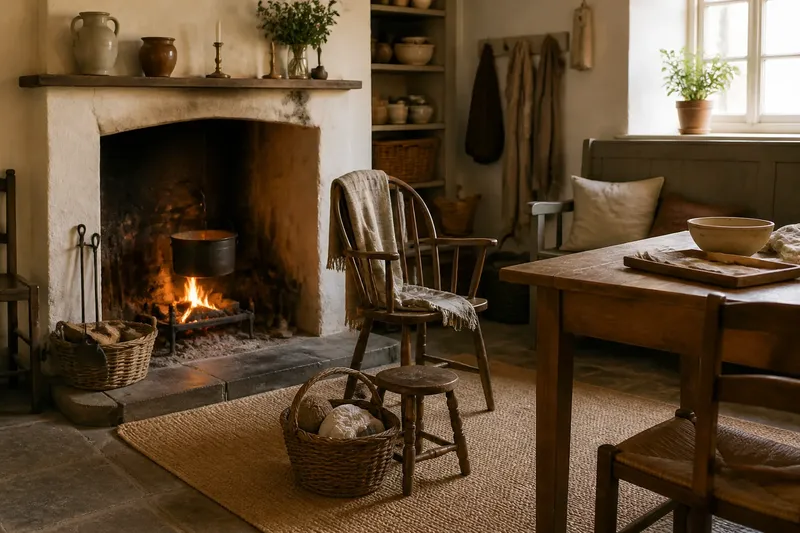
A mending basket sits beside the fireplace, a stool is pulled close, and a pot waits within reach. In this imagined cottage room, the hearth before the modern living room is a practical anchor: it helps shape where people gather, work and pause.
This is not a portrait of a particular period or region. It is a way to consider a room organised around a fixed fireplace, with movable furniture and several everyday uses. The focus is room character: how an anchor can give a shared space coherence without dictating every activity.
A fixed fireplace gives the room an anchor
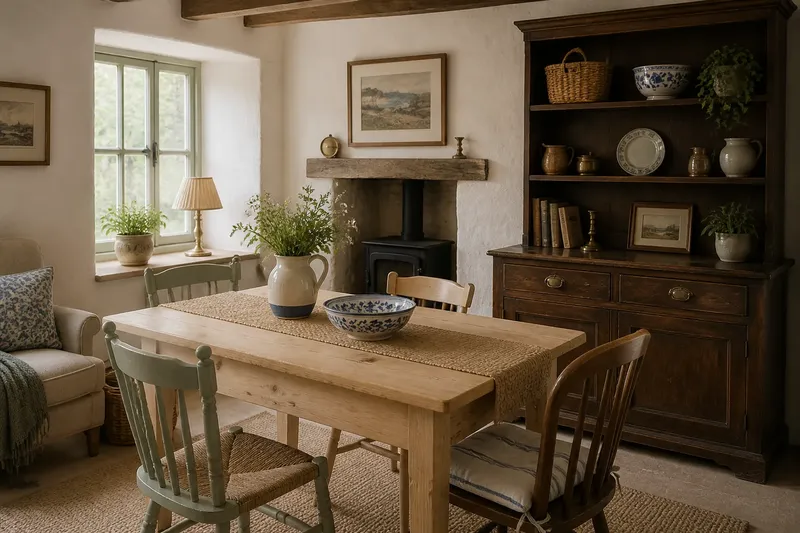
Imagine a cottage with one principal downstairs room. Its fireplace is built into a wall, beside a table, a few chairs, a settle, storage and stools that can be carried from place to place. The room has no separate sitting area in this invented household, so meals, small tasks and conversation share the same floor.
The fireplace stays put; the furniture does not. A chair can turn towards the warmth, while the table remains available for a meal or a task. The hearth may be the centre for warmth and attention, but it is not necessarily the centre of every activity.
For a cottage room today, the same design question can be asked without copying an imagined past: which feature already gives the room a sense of orientation? It might be a fireplace, a window seat or a broad table. Arrange other pieces to support it, while leaving clear routes between the door, seats and work surfaces.
Warmth and light bring everyday tasks together
In the imagined room, household activities overlap. Someone sorts clothing while another prepares food; a visitor may take a seat without bringing work to a halt. The table and storage remain useful, while the fireplace offers a place to warm up and attend to tasks that suit its position.
Say the household wants to mend a torn sleeve on a dim afternoon. A person carries the mending basket to a chair near the fireplace, where warmth makes sitting more comfortable. When the table is needed for a meal, the basket moves to the settle; the observable result is a clear table and a task that can continue elsewhere.
This arrangement differs from a modern living room whose main purpose may be sitting together. In the invented cottage, conversation can happen, but it shares the room with work, meals and storage. A bench may serve more than one purpose, and a patch of floor may be clear for one task and occupied for the next.
Movable seating makes company easy to accommodate
A settle offers a steady place to sit; a chair can be turned towards the fire or the table; a stool can be brought over and carried away again. These pieces need not form a permanent ring. Their usefulness lies in letting the room adjust to who is present and what they are doing.
In the invented cottage, one person sits near the fireplace to tend a pot, while another chooses a seat farther back to talk. A child moves a stool towards the table, then returns it beside the settle. The result is a room where people can keep one another company without everyone facing the same way.
That kind of welcome does not depend on a formal grouping of matching seats. People can talk across a task, listen while watching the fire or join in briefly. The room accommodates company without requiring ordinary work to stop.
The hearth before the modern living room offers a lesson in flexible layout
Now imagine that the household needs more table space. It brings in a larger table, which takes up more of the room. The settle stays near the fireplace, while a stool moves to a corner and a chair shifts towards the table. The fixed feature has not changed, but the path between the door and the work area needs attention.
Say the household wants a place for evening conversation while keeping the table usable. It turns the settle slightly towards the fireplace, leaves one chair on the other side and keeps the stools movable. The expected result is a loose gathering place that can open up again when someone needs the table. If the new angle narrows the route through the room, the household can turn the settle back and keep the chair as the more flexible seat.
For your own room, the practical test is simple: notice where people pause and whether they can reach the seats, door and table without weaving around furniture. A room feels more settled when its anchors and routes work together, not when every chair points towards one feature.
What readers often ask about hearth-centred rooms?
Was the hearth only used for cooking?
In this imagined room, the fireplace supports warmth as well as tasks connected with food. Its importance comes from the way it can draw attention and activity, not from one single use.
Did everyone sit close to the fire?
Not necessarily in the room described here: one person may sit near the warmth while another works at the table or chooses a seat farther back. The hearth can orient a room without deciding where everyone must sit.
How does this room differ from a modern living room?
The imagined cottage room combines work, meals, storage and conversation, rather than being reserved chiefly for relaxation. That distinction is about the planned household in this article, not a claim about every home in the past.
How can I use the idea in my cottage?
Identify a feature that already anchors the room, then arrange seats and tables around the ways you use the space. Keep a stool or chair easy to move if the room serves different purposes through the day.
A shared room gains character through ordinary adjustments
By evening, the pot has been moved, the mending basket put away and a stool drawn beside the settle. In the imagined cottage, the fireplace remains fixed while the rest of the room changes through ordinary actions. Its character comes partly from that balance: a clear sense of place, with enough flexibility for the next task.
What is not worth the effort is turning every chair towards a fireplace just to suggest an old-fashioned room. If that makes the table awkward to reach or blocks a route, the arrangement is working against daily life. A slight turn of one chair—or a stool kept within easy reach—can preserve the hearth before the modern living room as an idea of flexible, shared space without pretending to recreate a specific historical home.