Why a Low Window Changes the Feel of a Room
See how a low window changes a room’s visual balance, guides attention between the view, wall and furniture, and helps you arrange the space around it.
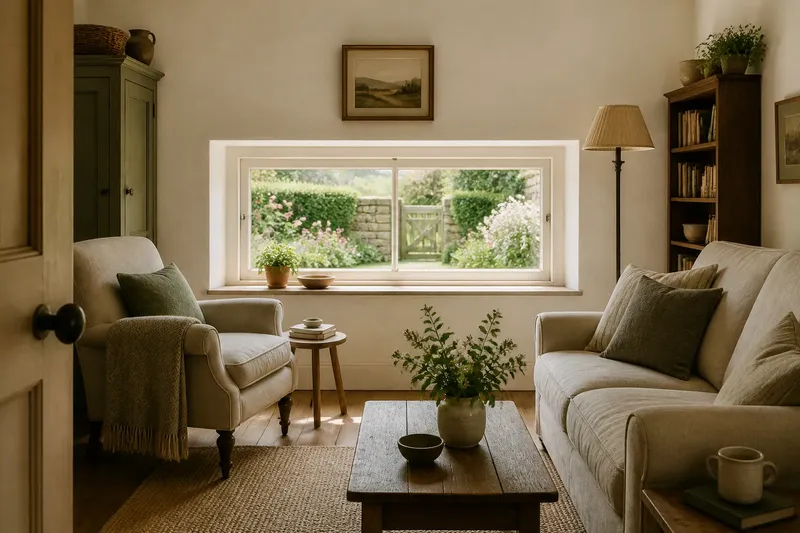
A low window can make a cottage sitting room feel as though it opens directly onto the garden. From the chair, the view sits close to eye level; from the doorway, the window becomes a broad, low shape that shifts the balance of wall and furniture. Understanding that change helps you arrange the room around what is already there, rather than treating the window as an awkward exception.
1. A low window brings the view into the room
With a high window, the outdoors often reads as a patch of light above the furniture. Lower glazing puts more of the garden into the room’s everyday sightline. You may notice a gate, a clipped hedge or the movement of leaves while seated, not only when standing near the glass.
That closer relationship can make the room feel more grounded. The view is not simply a bright feature near the ceiling; it becomes part of the same visual field as the chair, table and floor. A low sill can also make the garden feel nearer than its actual distance, especially when planting or a path continues the lines seen indoors.
Try sitting in the places where people actually pause: a reading chair, the end of a sofa or a kitchen chair pulled into the room. Notice what the glass frames from each position. The most compelling view may be a small patch of green or the changing light on a wall, rather than a grand prospect.
2. The broad wall above it changes the room’s balance
A low window leaves a larger field of wall above its frame than a window set higher in the same room. That uninterrupted area can make the ceiling feel taller, but it can also draw the eye upward and leave the lower half of the room feeling visually crowded. The effect depends on what sits beneath and beside the opening.
Look at the room from its entrance. If a tall cupboard occupies one side and a low window occupies the other, the eye may swing between two very different shapes: a solid upright mass and a horizontal opening. Neither needs to be hidden. The useful question is whether the surrounding objects give the view somewhere to settle, or pull attention away from it.
In a room with a plain wall above the glass, a small picture grouping or a simple mirror might help connect the window to the rest of the wall. Leave breathing space around the frame; a row of little objects scattered across the whole area can make the opening seem less deliberate. The aim is not to fill every empty patch, but to make the wall and window read as parts of one composition.
3. Furniture has a stronger relationship with the sill
A sofa or armchair placed in front of a low window can appear to sit directly in its frame. That may feel cosy when the furniture is low and the view remains visible over the back. A tall-backed chair, however, can block much of the garden and turn the glass into a strip of light above the upholstery.
Think about furniture height as well as distance from the wall. A low bench, a small occasional table or a compact chair may preserve more of the view than a bulky piece, even if both occupy similar floor space. Where the window is a favourite place to look out, keep the clearest sightline from the seats used most often.
Say you inherit a cottage room with a low window, a deep sofa and a narrow side table currently pressed against the glass. If the sofa back hides the view, you could move the sofa to a side wall and place the table beside the seat instead. The expected result is a clearer view from the sitting position and a more readable gap around the window, without adding anything to the wall.
4. The sill becomes a visible boundary, not just a ledge
At a low height, the sill sits closer to furniture tops and the objects people handle. It can form a strong horizontal line that links the window to a table, seat or run of skirting. When those lines are close but not quite aligned, the room may feel unsettled; when they are clearly separate, the difference can look intentional.
Notice the sill from across the room as well as beside it. A deep sill may hold a few modest objects, but a crowded row can compete with the view and create a cluttered band at eye level. A clear sill lets the window’s shape remain legible, while one or two carefully chosen objects can make the boundary feel lived in.
It is not worth buying a special display simply because the sill is low. If the view and the wall already feel balanced, leaving the ledge bare is a perfectly useful choice. The window’s low position is the feature; it does not need a collection arranged around it.
5. Curtains and blinds alter the shape you see
Window treatments can either emphasise the opening’s low, horizontal character or visually extend it. Curtains that gather heavily beside the frame add vertical folds, which may balance a long window but can make a small room feel busier. A simple blind keeps the outline quieter, though its fabric and colour still affect how much attention the window attracts.
Consider where the treatment sits when open. If curtain fabric covers a large part of the glass, the view can become pinched at the edges. If a blind stacks into a thick band over the window, it may make the opening appear shorter. A restrained treatment often lets the wall, sill and outdoor view do more of the work.
There is no single right choice for every cottage. A soft curtain can suit a room with bare boards and a plain wall, while a discreet blind may be easier to live with where furniture sits close to the frame. Check the treatment from the main doorway and from the chair, since those views reveal different proportions.
6. What should you look at before rearranging the room?
Does the view work from the main seat?
Sit where you usually read or talk and note what the window frames. If the view is mostly blocked, consider whether a different furniture position would open it before changing the window treatment.
Does a tall object pull the eye away?
Look for a bookcase, lamp or cupboard that forms a strong vertical beside the low opening. Moving a smaller object or shifting a seat may soften the contrast without leaving the room bare.
Is the wall above the window too empty or too busy?
View the wall from the doorway and judge it as one shape with the frame. If it feels unfinished, a single well-placed picture may connect the parts; if it already feels calm, leave it alone.
Do the sill and nearby furniture compete?
Compare the sill line with the top of a table, bench or sofa arm. A crowded cluster can be simplified, or a piece can be moved so the window has a clearer edge.
7. The room’s character comes from the view and the wall together
A low window does more than lower the apparent centre of the wall. It brings the garden closer to seated life, gives furniture a more immediate relationship with the outdoors and leaves a broad area of wall that can feel either restful or visually heavy. Those effects are connected: changing the seat can alter the view, and changing the treatment can alter the wall’s balance.
Start with the position from which the room is most often used. Then look at the window from the doorway, where the relationship between glass, wall and furniture becomes clearer. In a cottage room, the best arrangement is often the one that lets the view remain present without making every object point towards it. A low window can hold the room’s attention quietly, leaving the rest of the space free to be comfortable.
For a low window, the most useful adjustment is often a small one: an unobstructed chair, a clearer sill or a little more space around the frame. Notice how the view sits against the room’s familiar materials, from painted plaster to worn timber. Once that relationship feels settled, the window can shape the room without demanding a special display or a complete rearrangement.